- The Overwhelm Is About Volume, Not Difficulty
- Set a Time Limit Before You Start Researching
- Split Categories With Your Partner
- Decide Your Non-Negotiables Early
- Protect Time That Isn't About the Wedding
- Batch Similar Tasks Instead of Switching Constantly
- Stop Re-Researching the Same Things
- Delegate Beyond Just Your Partner
- Build in Actual Rest, Not Just Fewer Tasks
- Recognizing When It's More Than Normal Stress
- Give Yourself Permission to Not Optimize Everything
- Lower the Bar for What "Handled" Means
- Remembering Why You're Doing This
- Checking In With Each Other Regularly
- It Won't Feel This Way the Whole Time
- FAQ
If you typed "how to plan a wedding without stress" into Google because you're currently mid-spiral over centerpiece options, this one's for you. Planning a wedding is genuinely a lot, dozens of decisions, family opinions you didn't ask for, and a budget that always seems to stretch further than the money does. Here's what actually helps, beyond the generic "take a deep breath" advice.
The Overwhelm Is About Volume, Not Difficulty
No single wedding decision is hard. Picking a font for invitations isn't hard. Choosing a caterer isn't hard. What's hard is that you're making dozens of these small decisions in a compressed window, each requiring its own research and comparison. Naming the actual problem, volume, not difficulty, makes it easier to address, since the fix isn't "make better decisions," it's "reduce how many decisions demand your full attention at once."
Set a Time Limit Before You Start Researching
Give yourself a fixed amount of time per category before you even start looking, an hour for florists, thirty minutes for invitation wording, and stop when the timer goes off even if you haven't found "the one." Most categories have several genuinely good options, not a single correct answer waiting to be found. Open-ended research is what turns a thirty-minute decision into a three-week rabbit hole.
Split Categories With Your Partner
Trying to make every single decision together, as a unanimous two-person committee, is exhausting and usually unnecessary. Split categories based on who actually cares more: if one of you has strong opinions about music and the other doesn't, let music be that person's category, with a quick check-in before it's finalized. This cuts the total decision load roughly in half.
Decide Your Non-Negotiables Early
Sit down with your partner before the planning really ramps up and agree on which categories are non-negotiable to you both, and which ones you're genuinely open on. Family opinions and outside pressure land very differently when you already know where you stand versus when you're figuring it out in real time, mid-conversation, under pressure.
Protect Time That Isn't About the Wedding

It's easy for every dinner and every drive to turn into a planning meeting. Deliberately protect some time that's just you two, not talking about seating charts. The wedding is one day. The relationship underneath it is the actual point, and it's worth guarding some space for it during the planning stretch too.
Batch Similar Tasks Instead of Switching Constantly
Jumping between totally different categories, comparing venues in the morning, then vow-writing at lunch, then arguing about fonts in the evening, is mentally exhausting in a way that isn't obvious until you notice how drained you feel. Batching similar tasks together, a whole afternoon on vendor research, a separate evening dedicated to design decisions, reduces the mental switching cost and tends to make each session feel more productive rather than scattered.
Stop Re-Researching the Same Things
A genuinely underrated source of wasted time and stress: forgetting you already researched something and starting over from scratch. You compared three photographers two months ago and now can't remember which one you liked or why. This happens constantly when research lives across five apps, a notes file, and a camera roll with no labels.
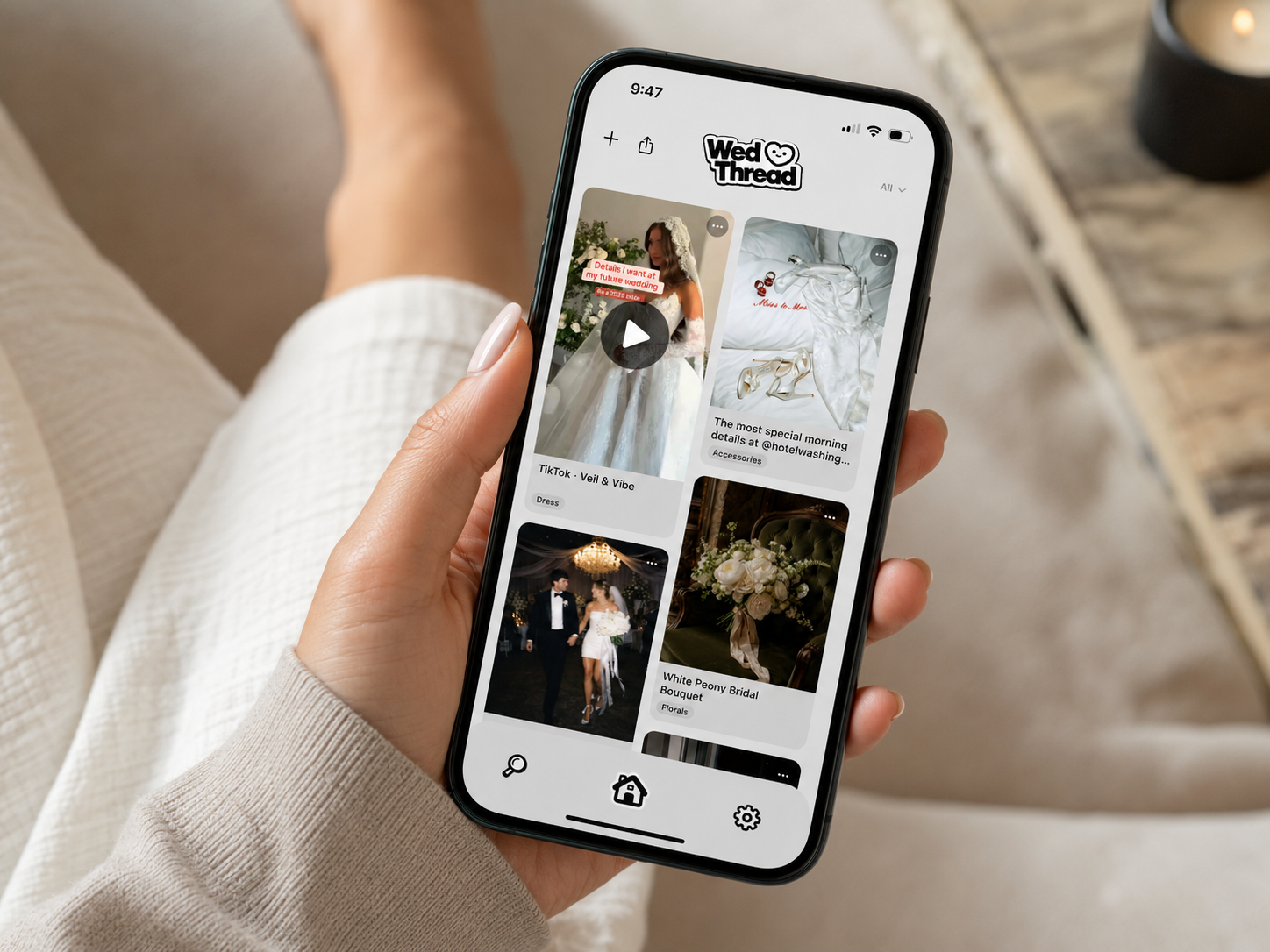
This is the specific thing WedThread is built to fix. It saves links, photos, and screenshots from anywhere, Instagram, Pinterest, TikTok, or a text from a friend, and sorts everything automatically into categories like Venue, Photographer, and Florals. When you go back to compare options, they're actually there, with your notes attached, instead of scattered across a search history you can't reconstruct.
Delegate Beyond Just Your Partner
Wedding parties and family often want to help but don't know what's actually useful. Give specific, bounded tasks rather than a vague "let me know if you need anything." Asking a detail-oriented friend to research three caterers and report back, or asking a parent to handle a specific vendor relationship they're already comfortable with, turns willing helpers into real relief instead of one more thing to manage. Most people who offer to help genuinely mean it, they just need a concrete way in.
Build in Actual Rest, Not Just Fewer Tasks

Stress relief during wedding planning isn't only about doing less, it's about actually resting when you're not planning. That means real breaks, a weekend with zero wedding-related tasks, not just a shorter to-do list. Planning tends to expand to fill whatever time is available for it, so if every free evening is a planning evening by default, burnout creeps up faster than expected. Block off specific stretches with nothing wedding-related on the agenda, and actually protect them.
Recognizing When It's More Than Normal Stress
Some stress and overwhelm is a normal part of planning something this big. But if it's affecting sleep consistently, causing real conflict with your partner that isn't resolving, or making you dread a day that's supposed to be joyful, that's worth paying attention to beyond just better planning habits. Talking to your partner honestly about how you're feeling, or bringing in outside support if needed, isn't a sign planning is going badly, it's a sign you're taking care of yourself through something genuinely demanding.
Give Yourself Permission to Not Optimize Everything
Not every decision deserves maximum research. Some things genuinely don't matter much, and treating every choice with the same intensity is a fast route to burnout. Save your energy for the handful of decisions that actually matter to you, and let the smaller stuff be good enough.
Lower the Bar for What "Handled" Means
A lot of planning stress comes from an unspoken expectation that everything needs to be handled perfectly, the ideal vendor, the ideal timeline, zero loose ends. In practice, "good enough and done" beats "perfect and still undecided three months later" almost every time. Give yourself explicit permission to make a decision, move on, and not revisit it. Most guests won't notice the difference between the best possible choice and a genuinely good one, but you'll notice the difference in how much mental space planning takes up.
Remembering Why You're Doing This

In the middle of spreadsheets and vendor emails, it's easy to lose sight of the actual point, marrying someone you love, surrounded by people who care about you. When planning starts to feel purely like project management, taking a moment to reconnect with that underlying reason tends to put the smaller stresses back into perspective.
Checking In With Each Other Regularly
Set a brief, recurring check-in with your partner specifically about how planning is affecting each of you individually, not just logistics. Catching rising stress or resentment early, before it builds up, is easier to address than a blowup that's been building silently for weeks.
It Won't Feel This Way the Whole Time
Wedding planning has genuine highs mixed in with the overwhelming stretches, picking a venue you love, finding the dress, watching the pieces come together. The stressful moments are real, but they're not the whole story.
Mostly volume. It's not any single decision that's hard, it's dozens of small decisions arriving at once, each requiring research, comparison, and a choice. The overwhelm is usually about quantity, not difficulty.
Set a time limit before you start researching a category, an hour for florists, thirty minutes for invitation wording, and stop when the timer's up even if you haven't found the perfect option. Most categories have several genuinely good choices, not one correct answer.
As much as they want to be, but at minimum, involved in the decisions that actually matter to both of you. Splitting categories by who cares more about them tends to work better than trying to make every decision together.
Very. Planning a wedding while also managing family dynamics, budgets, and a full-time job is genuinely a lot. Occasional overwhelm doesn't mean anything's wrong, it means you're planning a wedding.
Decide ahead of time, with your partner, which categories are non-negotiable to you both and which ones you're open to input on. Having that line clear in your own head makes it much easier to hold when someone pushes.
Not re-researching things you already looked into. A shocking amount of wasted time comes from forgetting you already compared three photographers and starting over. Keeping your research somewhere you can actually find it again saves more time than any productivity trick.
A big chunk of planning stress comes from feeling like everything's scattered, ideas in five apps, screenshots you can't find, decisions you've half-made but can't remember why. WedThread keeps everything you've saved in one searchable place, which removes a surprising amount of the background anxiety.